“We Realized We Had Become ○” Exhibition
2026.04.01–2026.04.07
AVA artist-run-space (Taito, Tokyo)
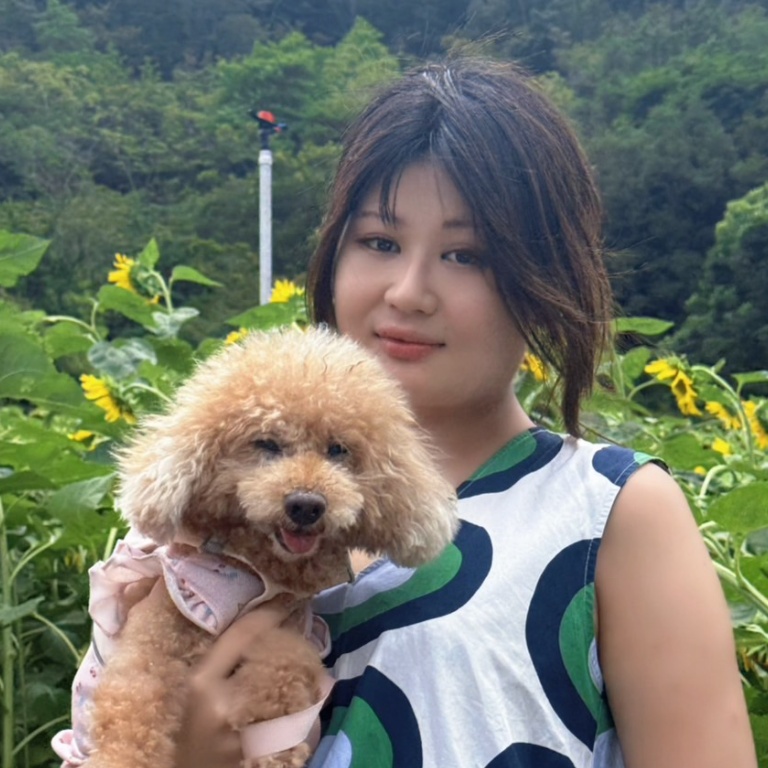
Nene Koyama
Born in Gifu, Japan, in 1999.
Completed the Graduate School of Art at Tama Art University in 2025.
She then spent one year as a researcher at the Takinoue Laboratory, Laboratory for Chemistry and Life Science, Institute of Integrated Research, Institute of Science Tokyo, where she pursued artistic production and research related to bioart.
Since 2026, she has been enrolled in the doctoral program in the Department of Electrical Engineering and Bioscience, Graduate School of Advanced Science and Engineering, Waseda University, researching artistic expression across aesthetics and science.
Her practice centers on kinetic art and bioart, exploring “relationships between humans and nonhumans” and “humans as seen from nonhuman perspectives.”
Since childhood, she has been drawn to living creatures and “things that move,” developing an interest in questions such as how nonhuman beings perceive the world and where the boundary between life and nonlife lies.
From these interests, her practice has expanded into kinetic expression using electronics and bioart.
She also reconsiders how humans perceive, assign meaning to, and appreciate other beings, exploring forms of perception and appreciation that do not take humans as the sole standard.
Activities / Background
Exhibitions
2026.04.01–2026.04.07
AVA artist-run-space (Taito, Tokyo)
2025.12.18–2025.12.22
Waseda University, Nishi-Waseda Campus (Shinjuku, Tokyo)
2025.10.25
Iki Island (Nagasaki)
2025.07.11–2025.07.13
100BANCH (Shibuya, Tokyo)
2025.03.07–2025.03.09
BankART KAIKO (Yokohama, Kanagawa)
2025.01.10–2025.01.13
Tama Art University, Hachioji Campus (Hachioji, Tokyo)
2024.10.01–2024.10.06
Tama Art University TUB, Midtown Tower 5F (Minato, Tokyo)
2024.08.10–2024.08.24
Sagamihara City Museum (Sagamihara, Kanagawa)
2024.07.13–2024.07.14
Tama Art University, Hachioji Campus (Hachioji, Tokyo)
2024.06.16–2024.07.17
Unicom Plaza Sagamihara (Sagamihara, Kanagawa)
2024.03.08–2024.03.10
Kitasenju BUoY (Adachi, Tokyo)
2023.12.16
The University of Tokyo, Komaba II Campus
2023.12.05–2023.12.07
Tama Art University, Multipurpose Seminar Rooms 22-308/309
2023.12.04–2023.12.24
TUB Midtown Design Hub
2023.10.14–2023.10.15
Tokyo Big Sight
2023.08.01–2023.08.20
NTT InterCommunication Center [ICC], Gallery A (Tokyo)
2023.02.24–2023.02.26
3331 Arts Chiyoda (Chiyoda, Tokyo)
2023.01.12–2023.01.15
Tama Art University, Hachioji Campus (Hachioji, Tokyo)
2022.02.24–2022.03.05
Labcafe (Hongo-sanchome, Tokyo)
2022.01.29–2022.01.30
Sagamihara Citizens Gallery (Sagamihara, Kanagawa)
2021.11.16–2021.11.18
Tama Art University, Information Design Building 3F
2021.07.17–2021.07.18
Tama Art University, Information Design Building 2F, Room 206
Works / Catalogue
WORK 01 / 2023
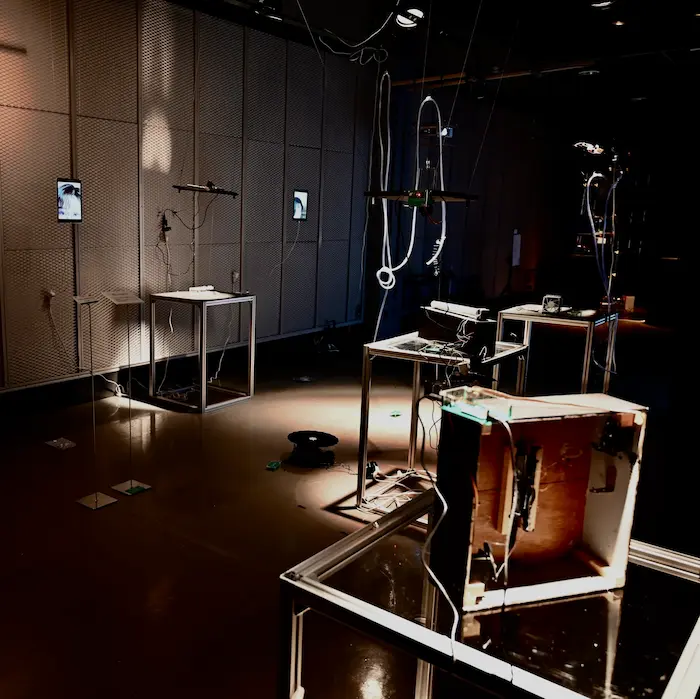
What if “☆¿※◉♯” mimics me?
Media Installation
2023
I call the act of things understanding humans by analogy with things “objectification.” This series imagines the artist’s body and movement as seen from objects in a room, and presents those imagined forms as kinetic sculptures.
BACKGROUND / PROCESS / WORK 01
Humans often understand nonhuman entities by likening them to people — anthropomorphism. This work began with the reverse question: if objects were to understand humans, what kind of forms would humans take from their point of view?
Assuming that objects such as computers, chairs, and intercoms each have different modes of contact and different worlds within the same living space, the work attempts to invert a human-centered perspective.
I call the act of things understanding humans by analogy with things “objectification.” This series imagines the artist’s body and movement as seen from objects in a room, and presents those imagined forms as kinetic sculptures.
The human figure was reconfigured from multiple viewpoints, including those of a computer, ice cream, bread, a bed, tea, glasses, a hair dryer, lighting, an intercom, and face mites.
I observed relationships between everyday objects and people, extracting the body parts and human movements with which each object comes into contact. These were translated into different forms and movements, and realized as multiple kinetic sculptures using Arduino, servo motors, stepper motors, discarded objects, and other materials.
WORK 02 / 2025
Study Work
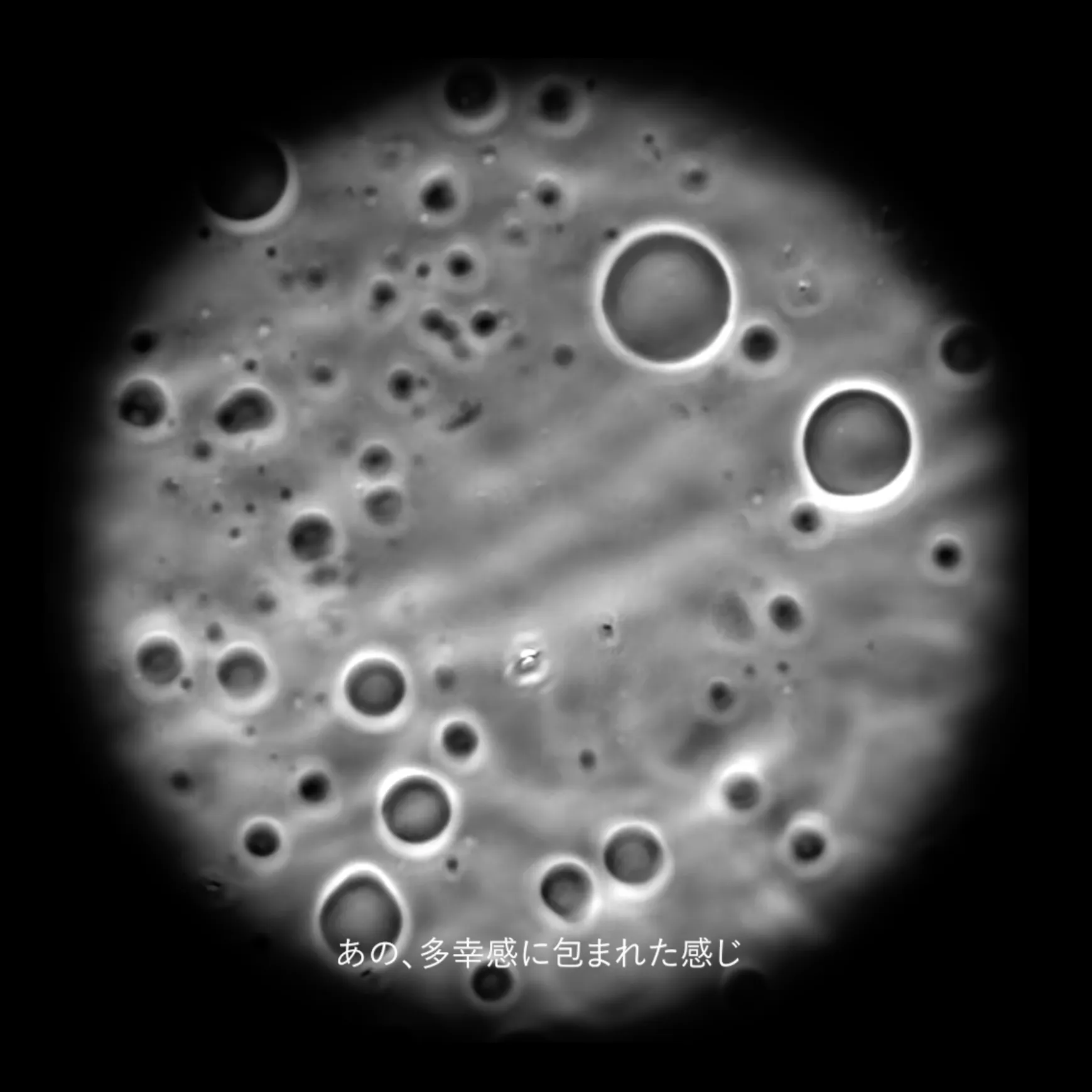
Study Work
A performance of human birth by the nonhuman
2025
A study in which nonhuman entities perform the story of human birth. Using light-responsive DNA droplets, the work approaches the boundary between living and nonliving matter, and the idea of “birth,” from a nonhuman perspective.
IMAGES / 2025
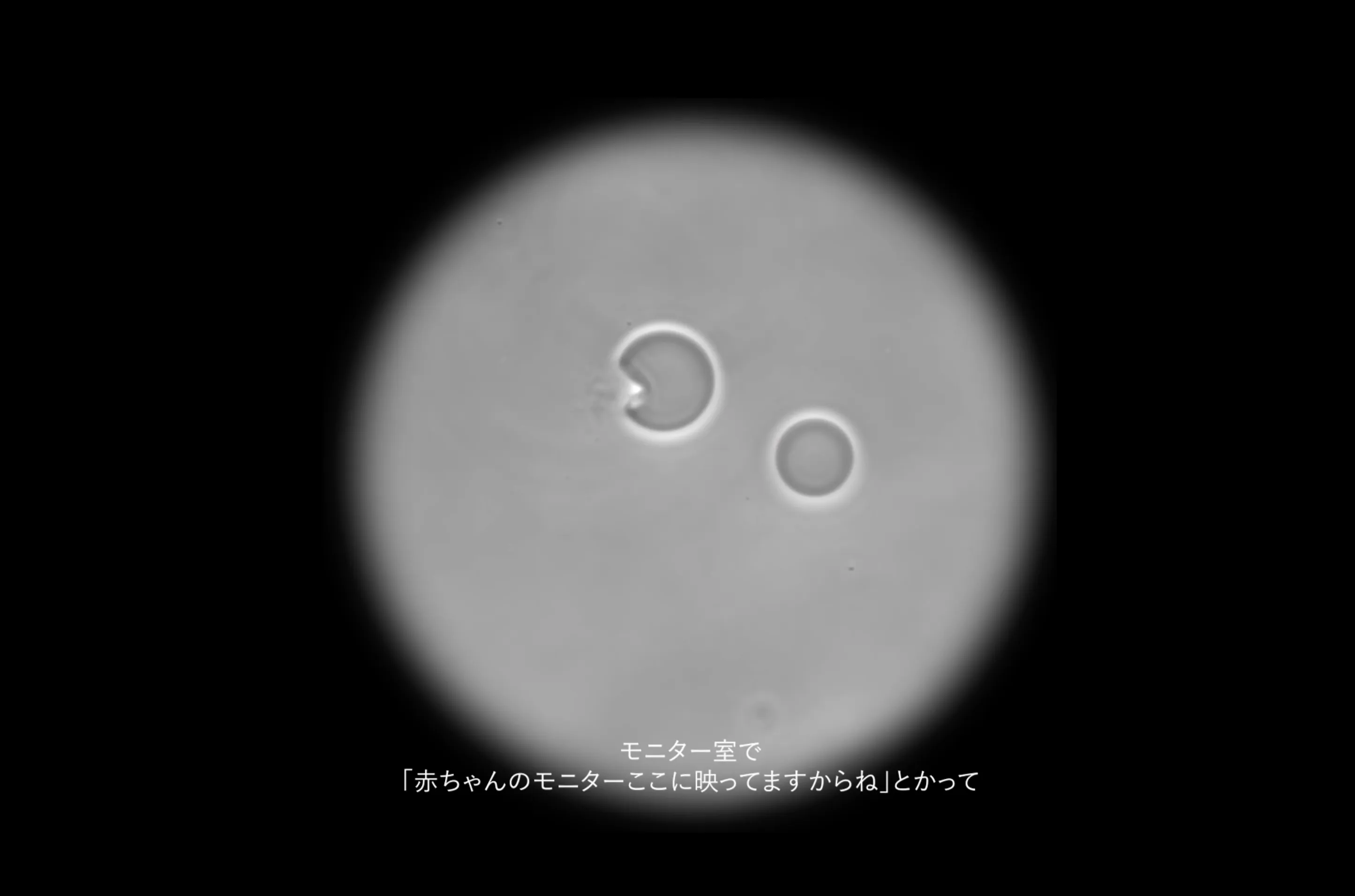
Installation view
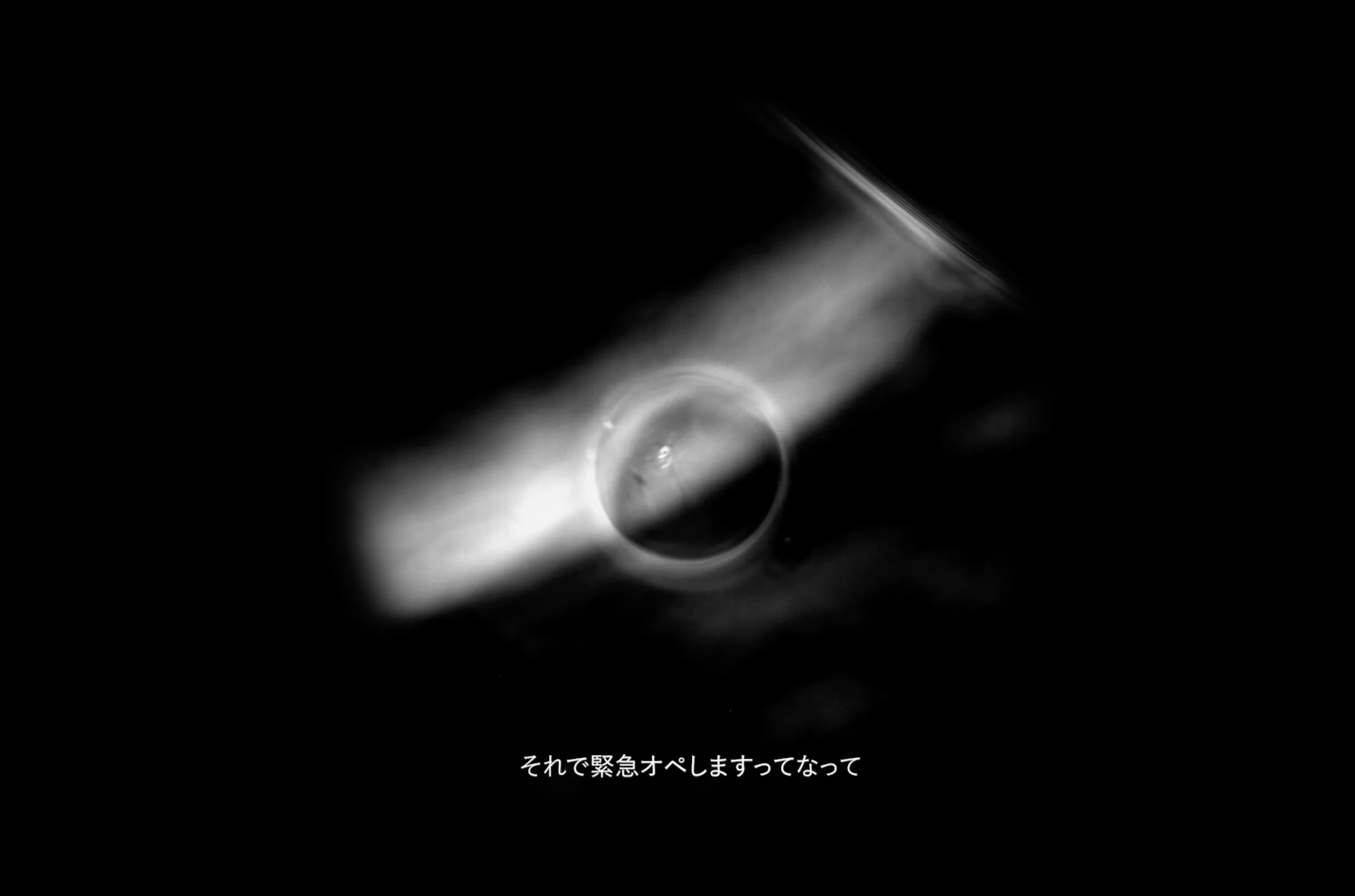
Installation view
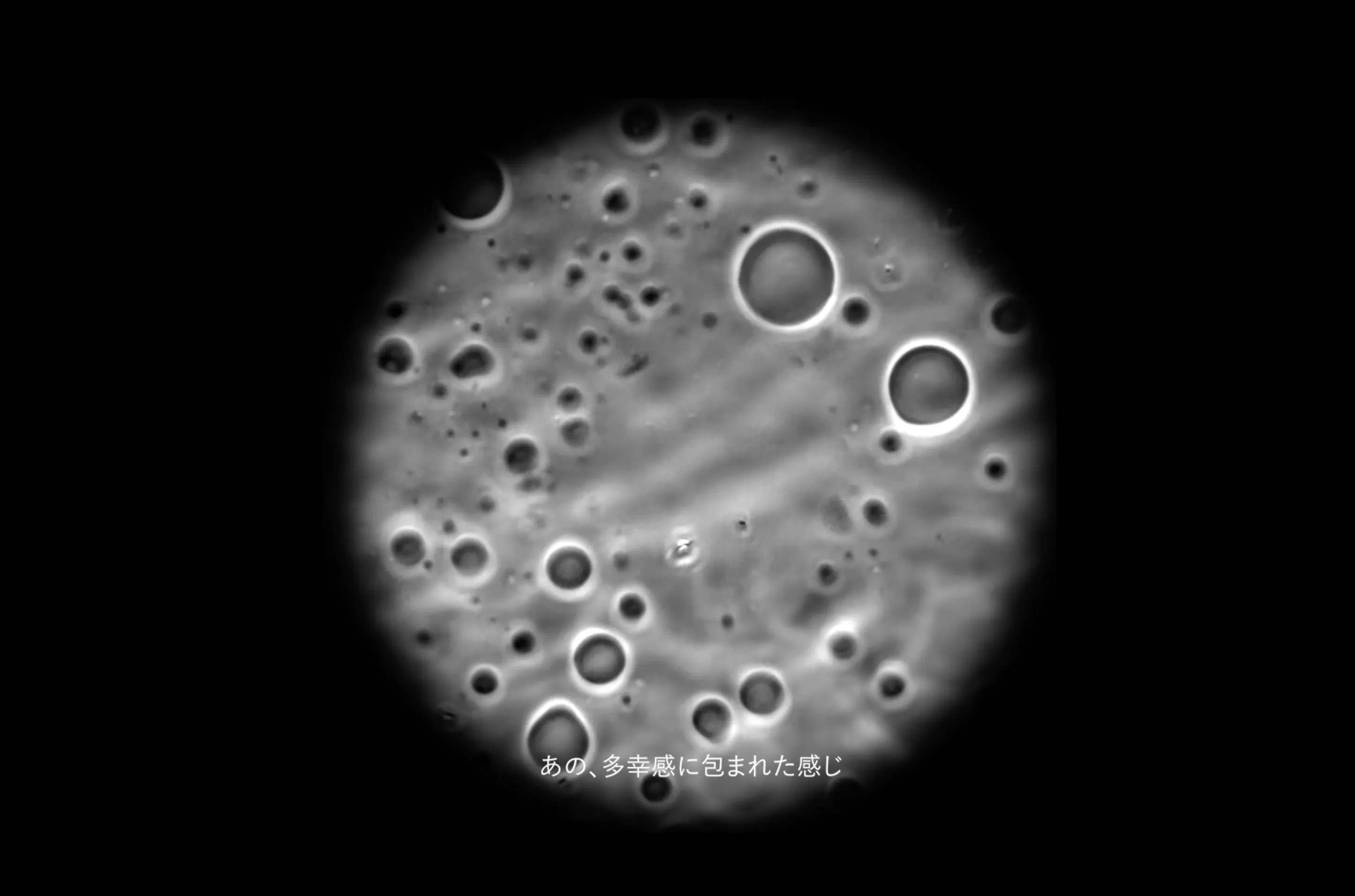
Detail
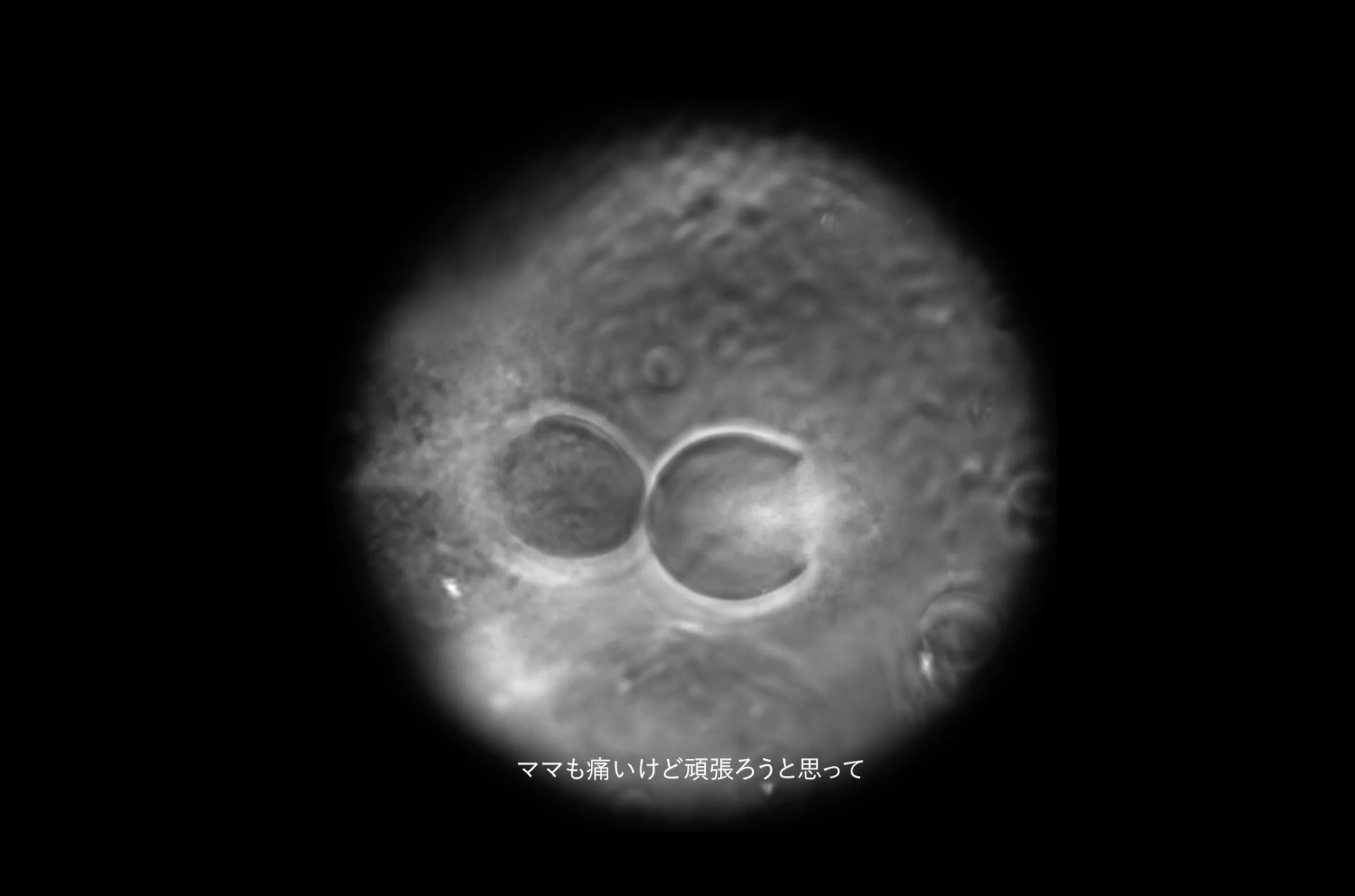
Detail
BACKGROUND / PROCESS / WORK 02
The work grows from an interest in the boundary between living and nonliving matter, and in what it means to be born as an individual. It imagines nonhuman entities performing human birth.
Rather than having humans narrate their own birth, the work asks what the event of “birth” might look like when performed by beings that are not human.
This study treats light-responsive DNA droplets as nonhuman performers. By observing the movement of the droplets themselves, it explores how the story of human birth might be entrusted to nonhuman agents.
With scientific collaboration and technical guidance from the Takinoue Laboratory at Institute of Science Tokyo, the project uses light-responsive DNA droplets as material and develops the work through observation of their behavior. At this study stage, it examines the relationship between droplet movement and theatrical composition.
WORK 03 / 2024
BioArt Installation
BioArt Installation
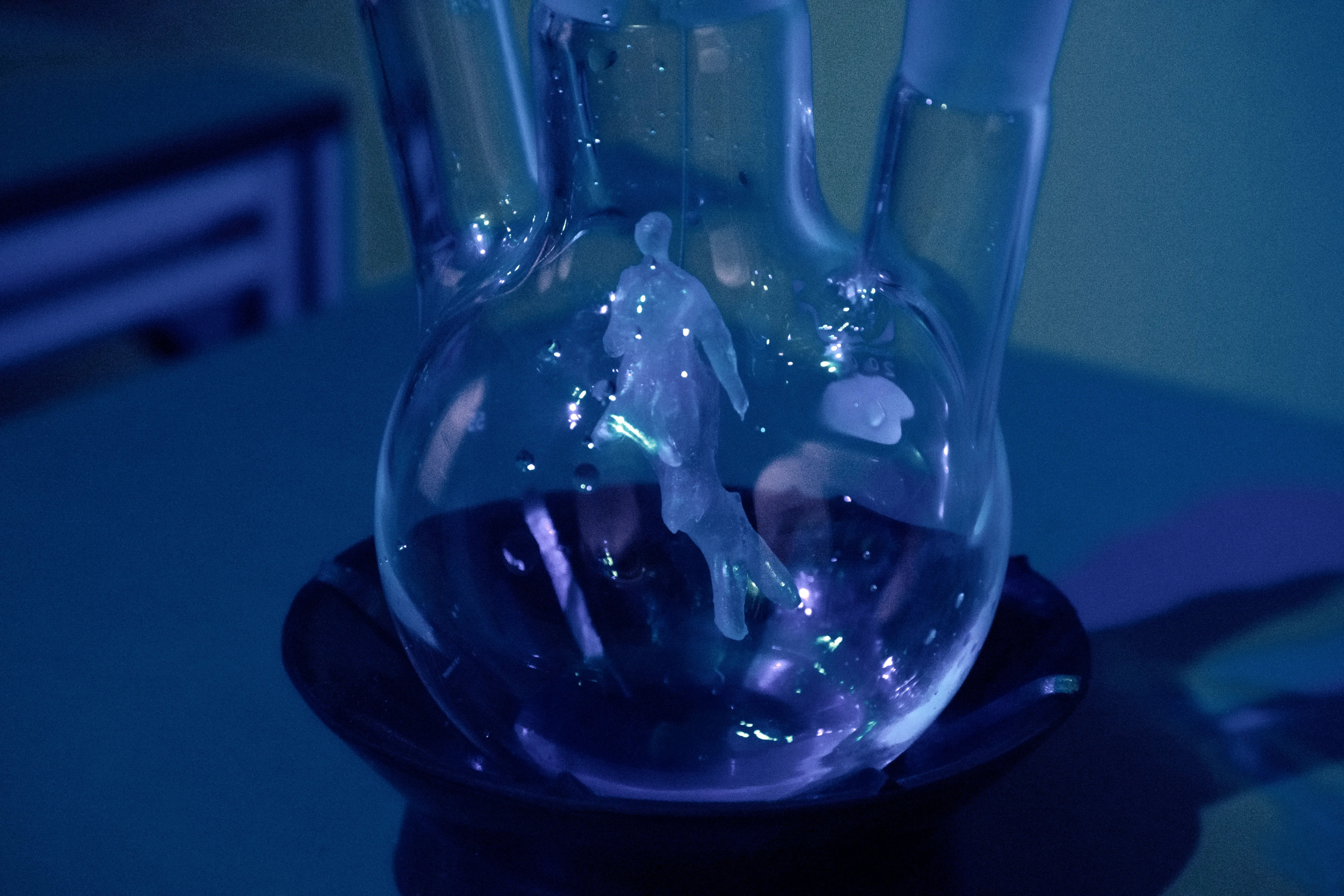
Mermaid's Flesh
2024
This work cultivates human and fish cells under different culture conditions in an attempt to recreate the flesh of the mythical mermaid through cell culture.
During the exhibition, cells are cultured in three vessels shaped as a human, a fish, and a mermaid, and continue to proliferate throughout the exhibition period.
At the scale of the cell, the work considers the boundary between human and nonhuman, the conditions by which species are distinguished, and the question of what it means to be human.
IMAGES / 2024
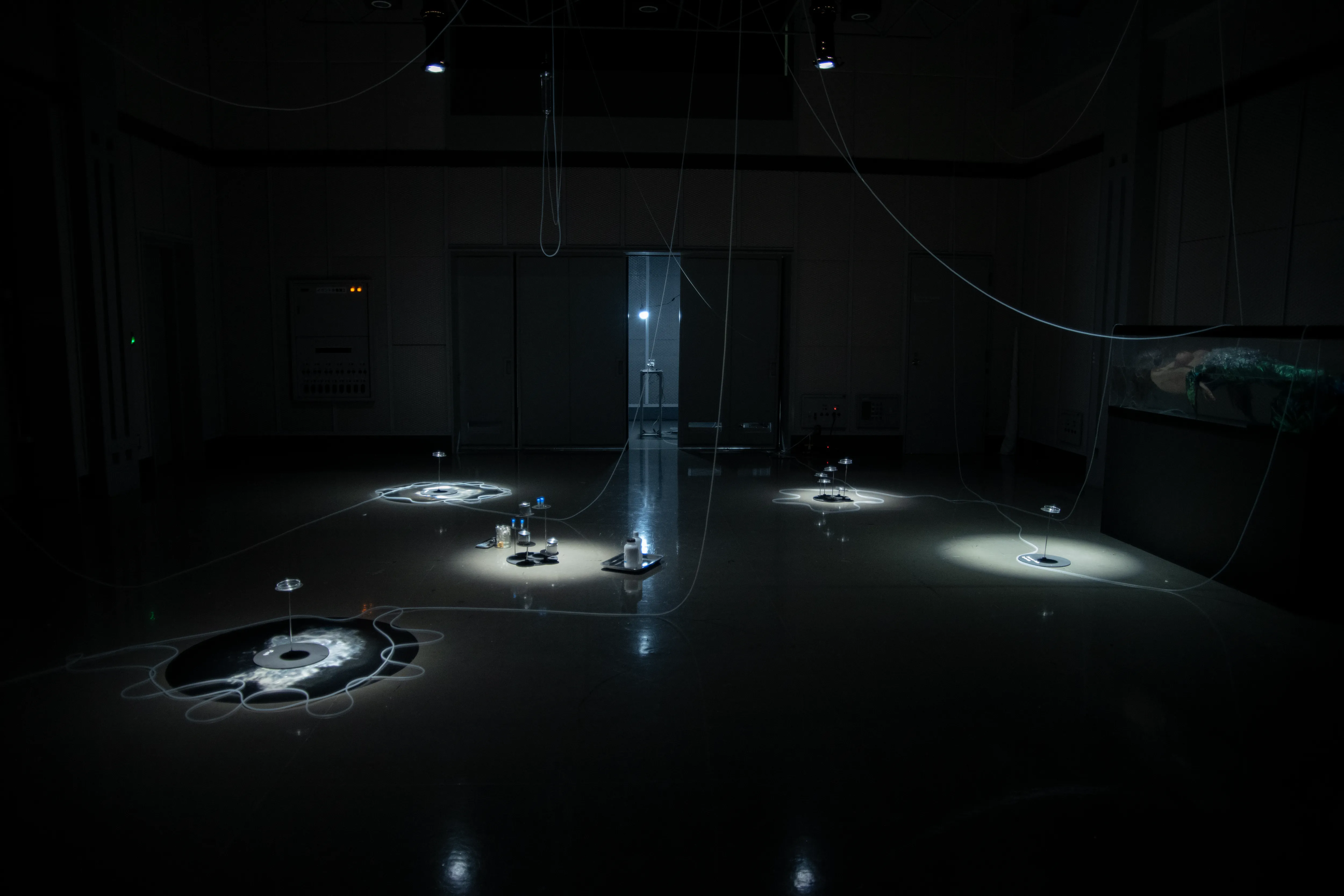
Installation view / Photo: Yuki Kobayashi
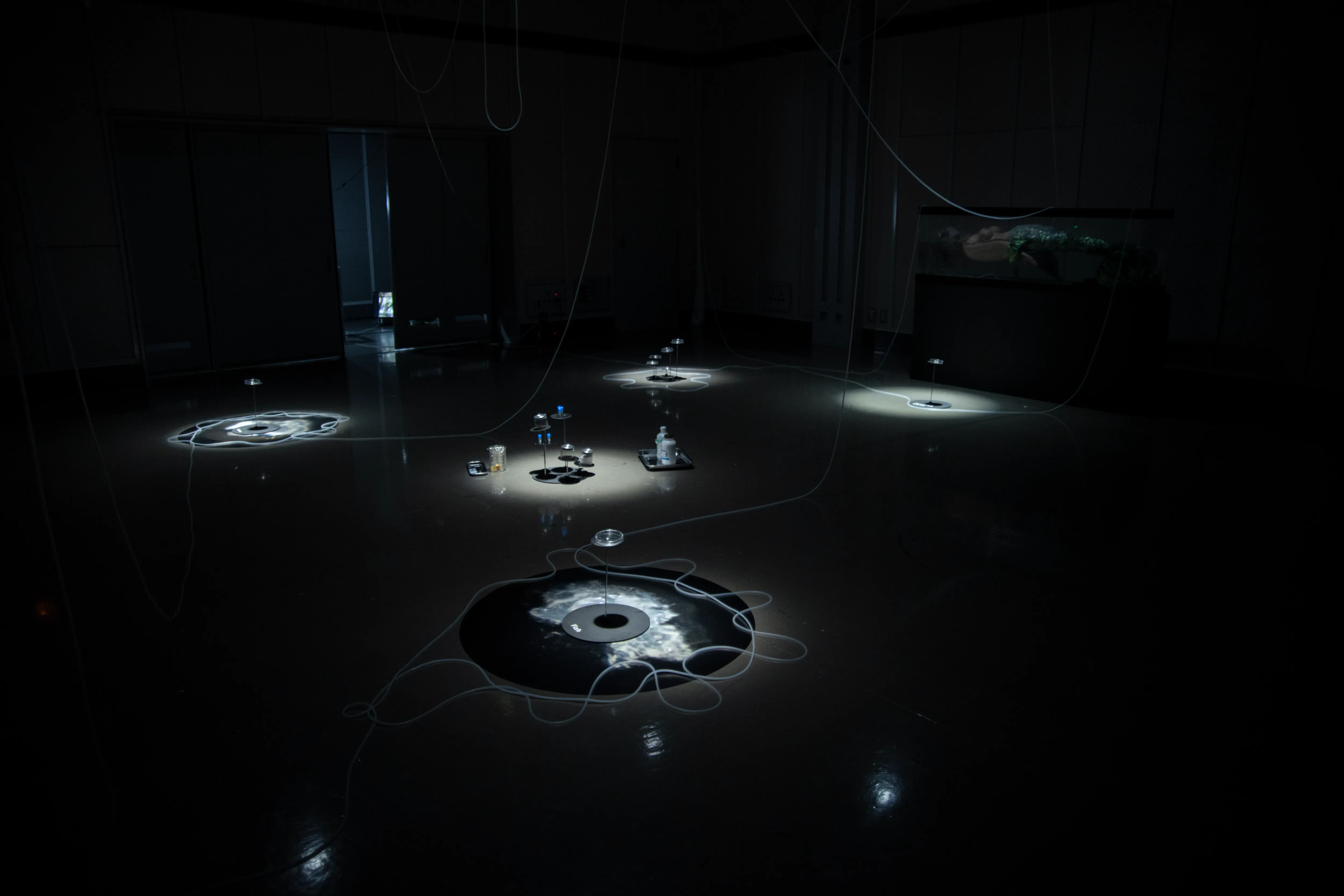
Installation view / Photo: Yuki Kobayashi
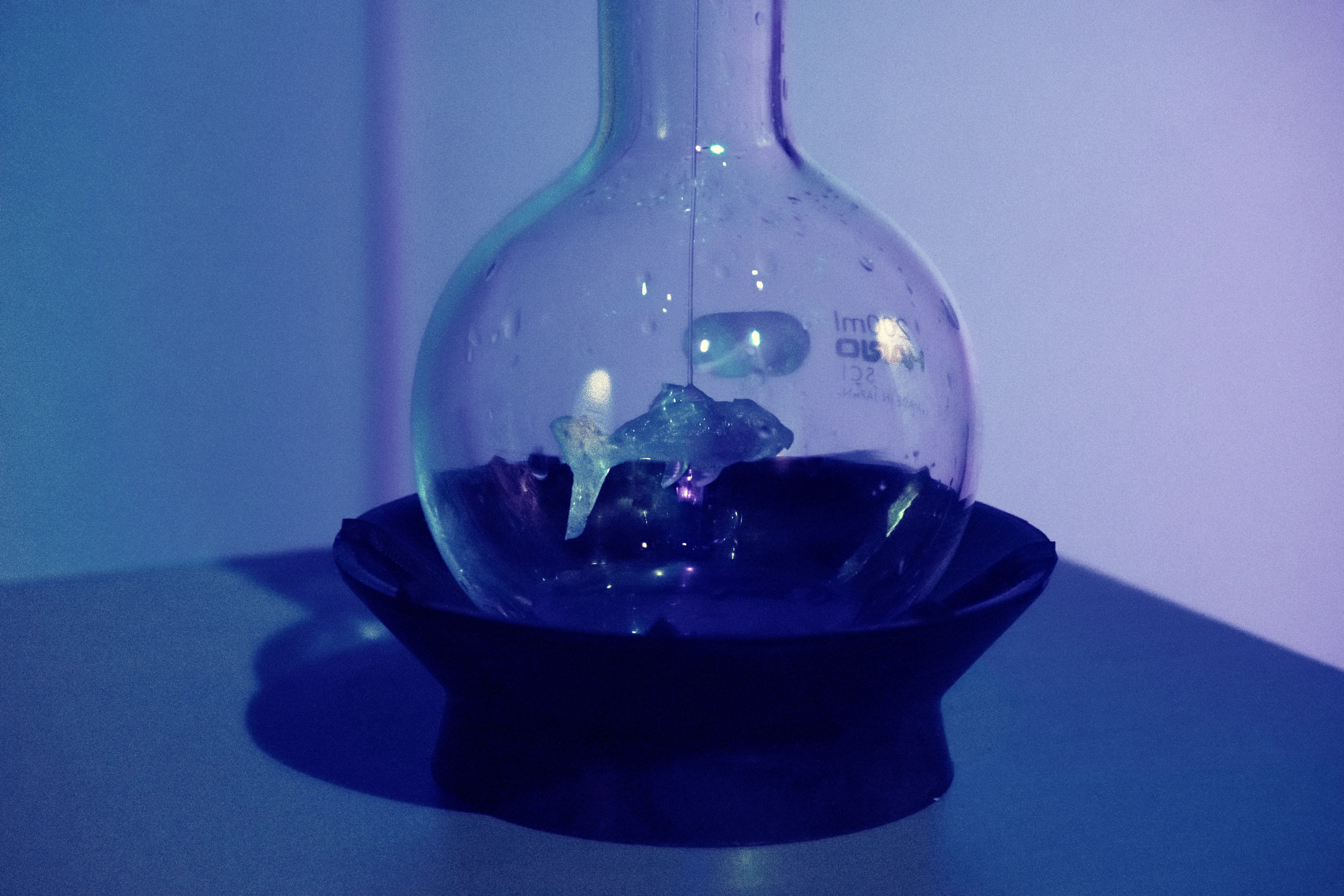
Detail / Photo: Yuki Kobayashi
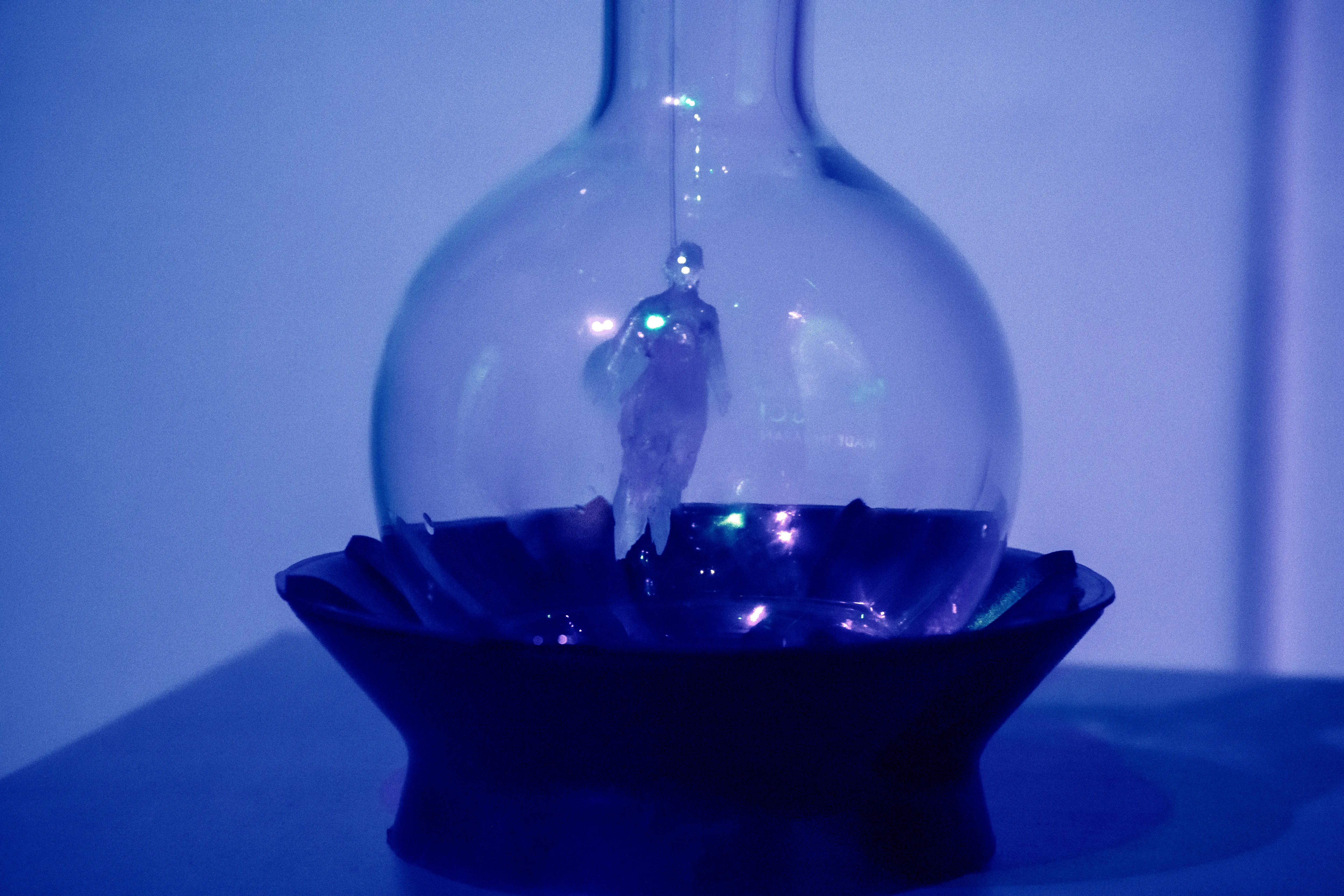
Detail / Photo: Yuki Kobayashi
BACKGROUND / PROCESS / WORK 03
In cell culture, the conditions for survival and proliferation are shaped not only by the cell type but also by the surrounding environment, including culture medium and serum. The work begins by reconsidering the boundary between human and fish through combinations of cells and culture environments.
The project attempts to recreate the flesh of the mythical mermaid through cell culture. By juxtaposing three conditions — human-shaped, fish-shaped, and mermaid-shaped — it asks where the categories “human,” “fish,” and “mermaid” come into being.
Three culture conditions were established: human cells with fish-derived serum; fish cells with human-derived serum; and alternating cultures of human and fish cells. These were assigned respectively to human-, fish-, and mermaid-shaped vessels and grown in a gel-like medium. The continuing culture process during the exhibition itself was presented as part of the work.
WORK 04 / 2024
Video Installation
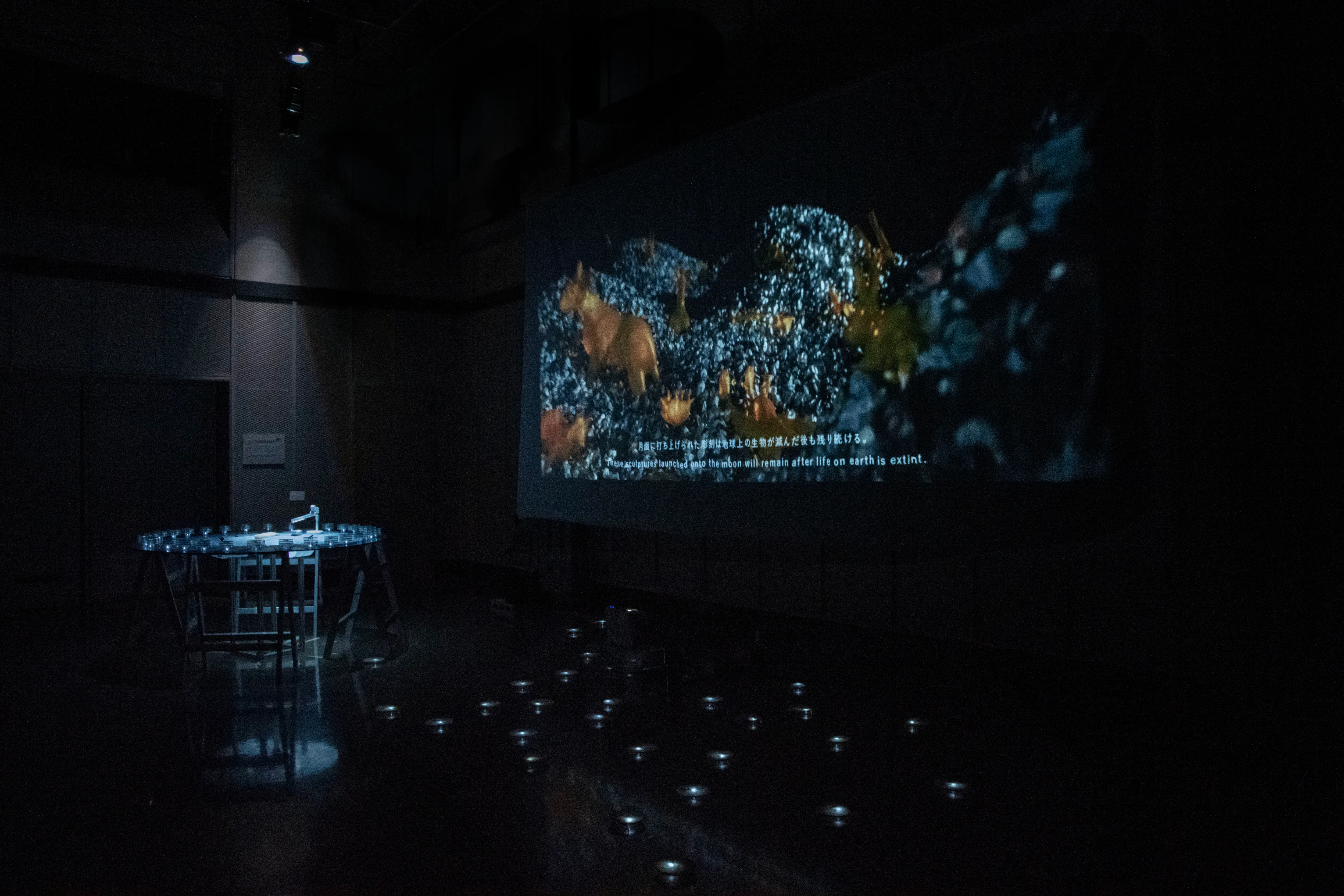
Video Installation
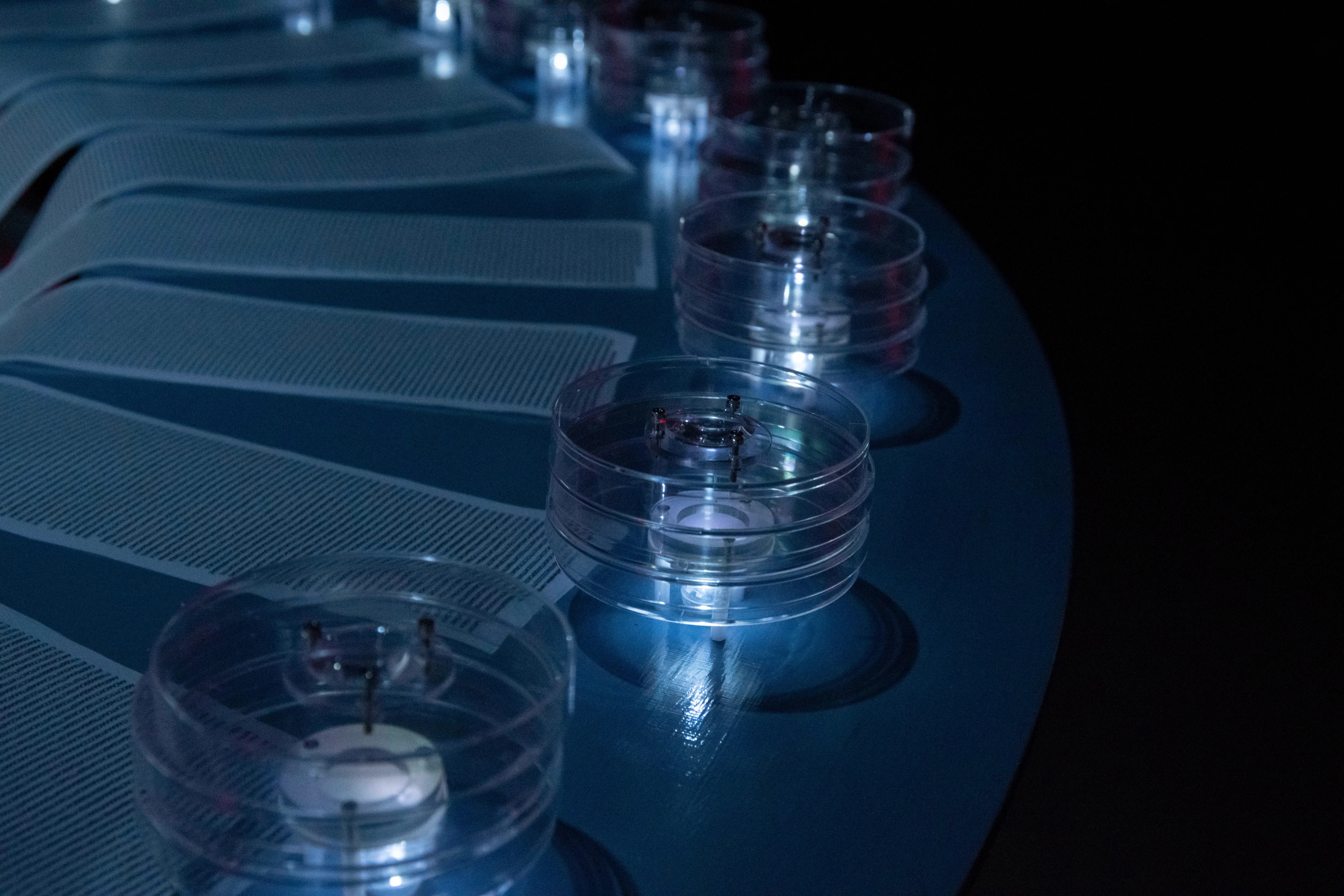
Luna micro sculpture exhibition “Noah’s Ark”
2024
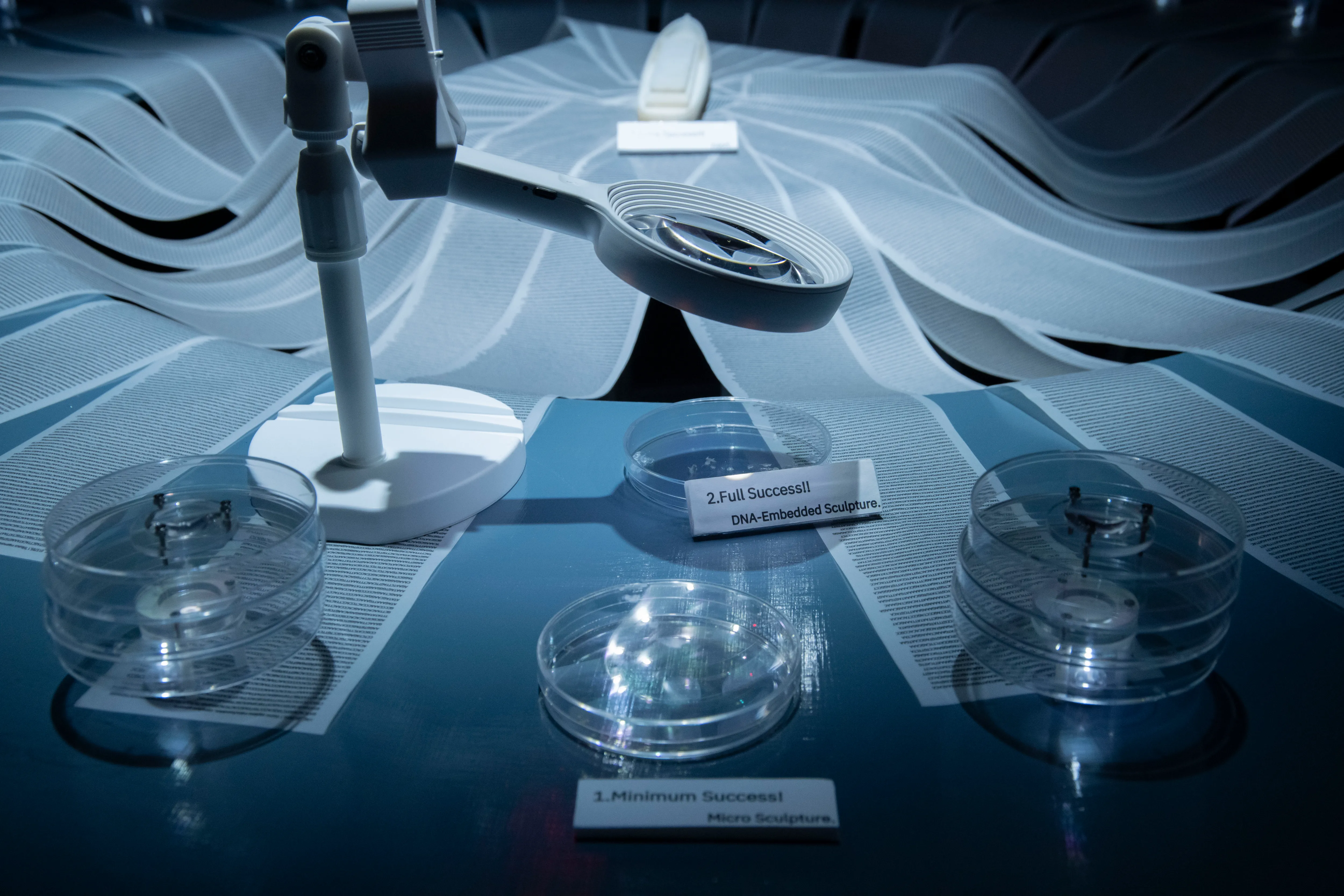
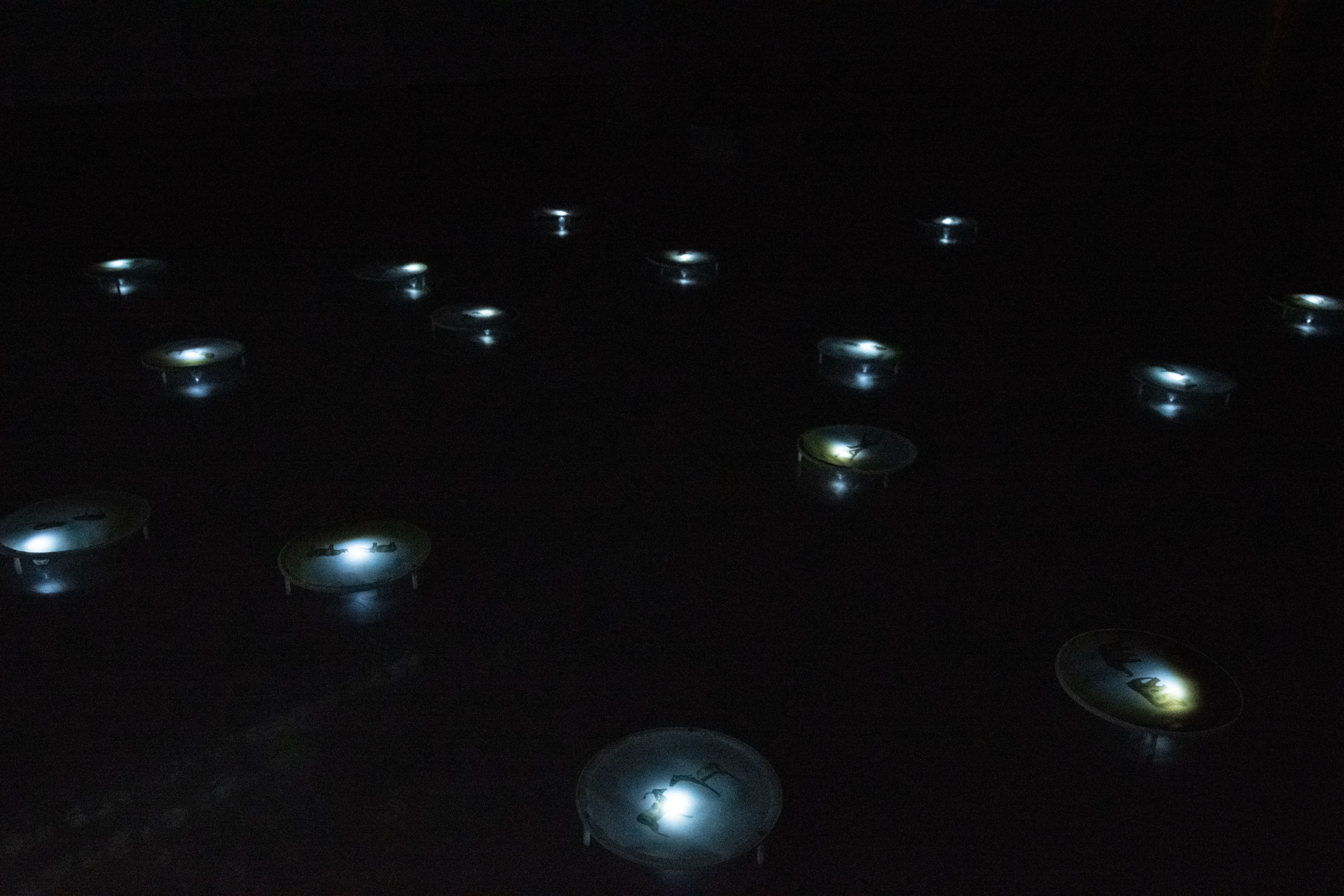
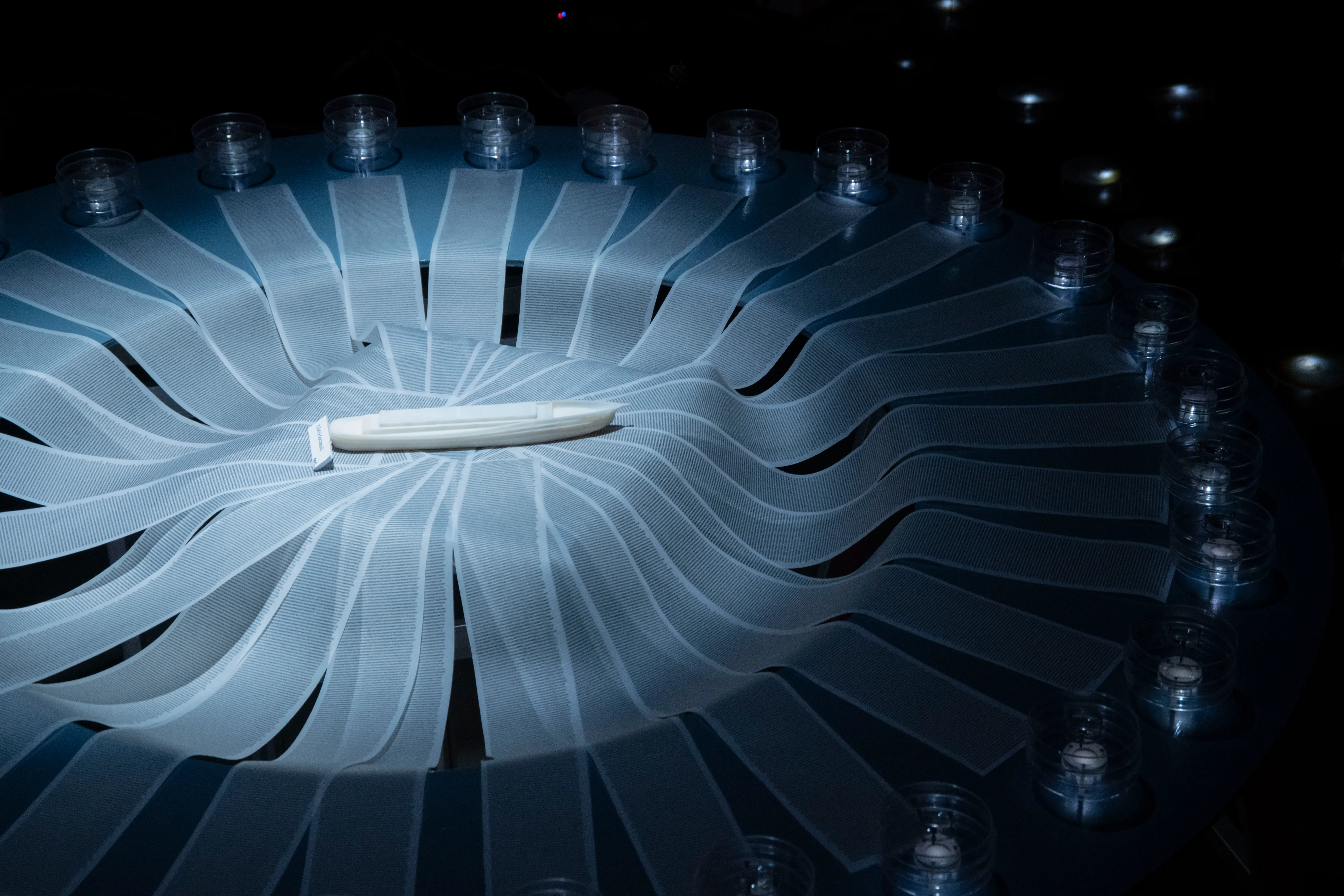
A project that imagines making art on the Moon by transporting microscopic sculptures containing animal genetic information and releasing them onto the lunar surface, like a “Noah’s Ark.” It considers the possibilities of lunar art through constraints of transportation cost, weight, and scale.
IMAGES / 2024
Installation view
Installation view
Detail
Detail
BACKGROUND / PROCESS / WORK 04
The project began with the question of what could actually be exhibited on the Moon under constraints unlike those on Earth, including transportation cost, weight, and scale.
It also imagines an unknown intelligence in the future, rather than humans, as its audience, and considers how traces of life that once existed on Earth might remain.
The project proposes an unmanned exhibition in which numerous 0.5 mm micro-sculptures containing animal genetic information are carried to the Moon in a satellite modeled after Noah’s Ark and released onto the lunar surface.
If they are discovered after humanity is gone, the sculptures are intended to function as a memory device for life on Earth.
Thirty animal species were produced as micro-sculptures, one male and one female of each, for a total of sixty. In March 2024, a concept video was filmed in a lunar-surface test field at the JAXA Space Exploration Innovation Hub. DNA-containing sculptures were produced in June and exhibited in December. In 2025, DNA was embedded in the sculpture gel and a verification test was carried out to identify the animal species from the DNA recovered from the sculptures.
WORK 05 / 2023
Installation Art
Installation Art
Translate the object as seen by the creatures I lived with.
2023
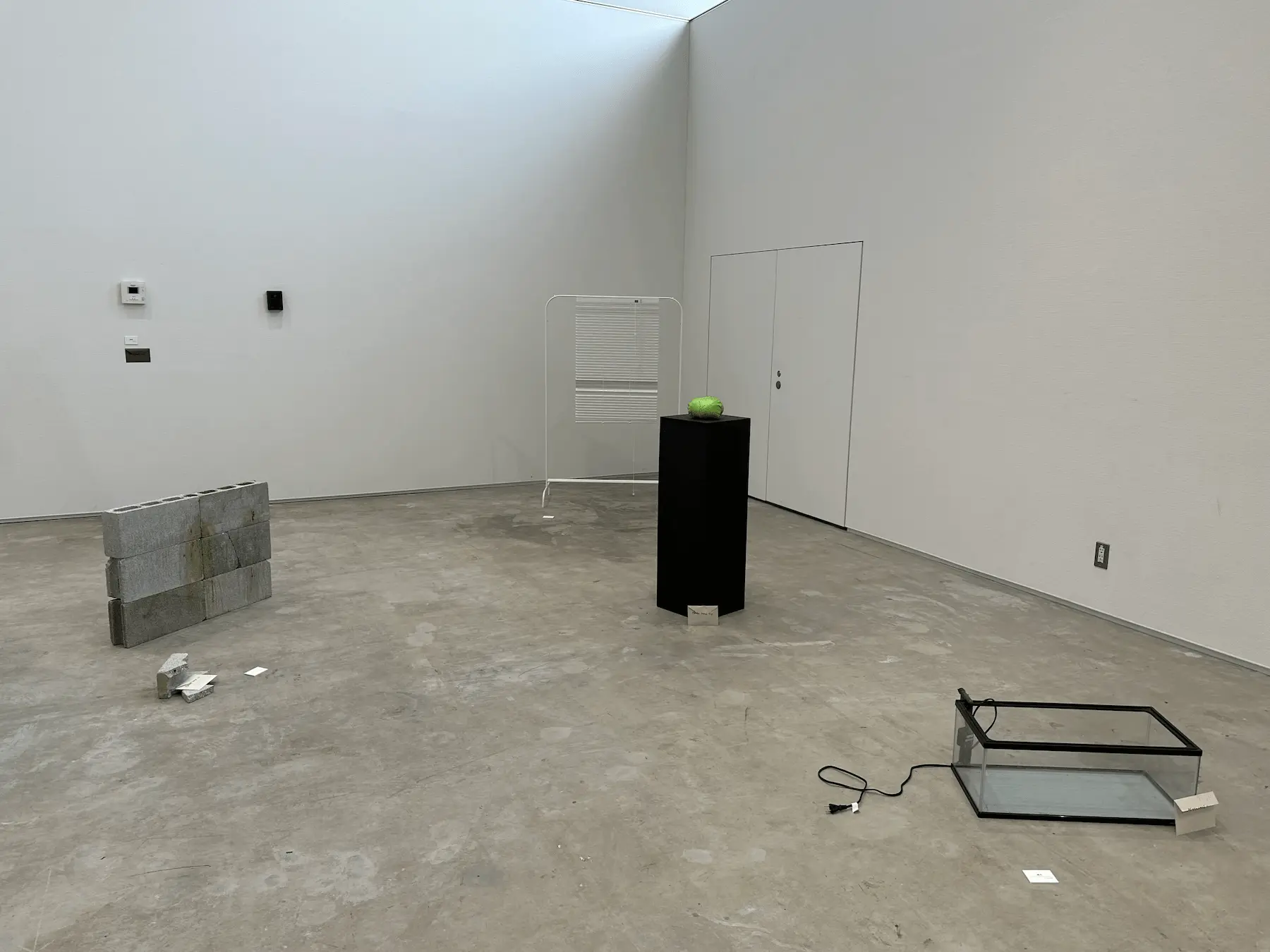
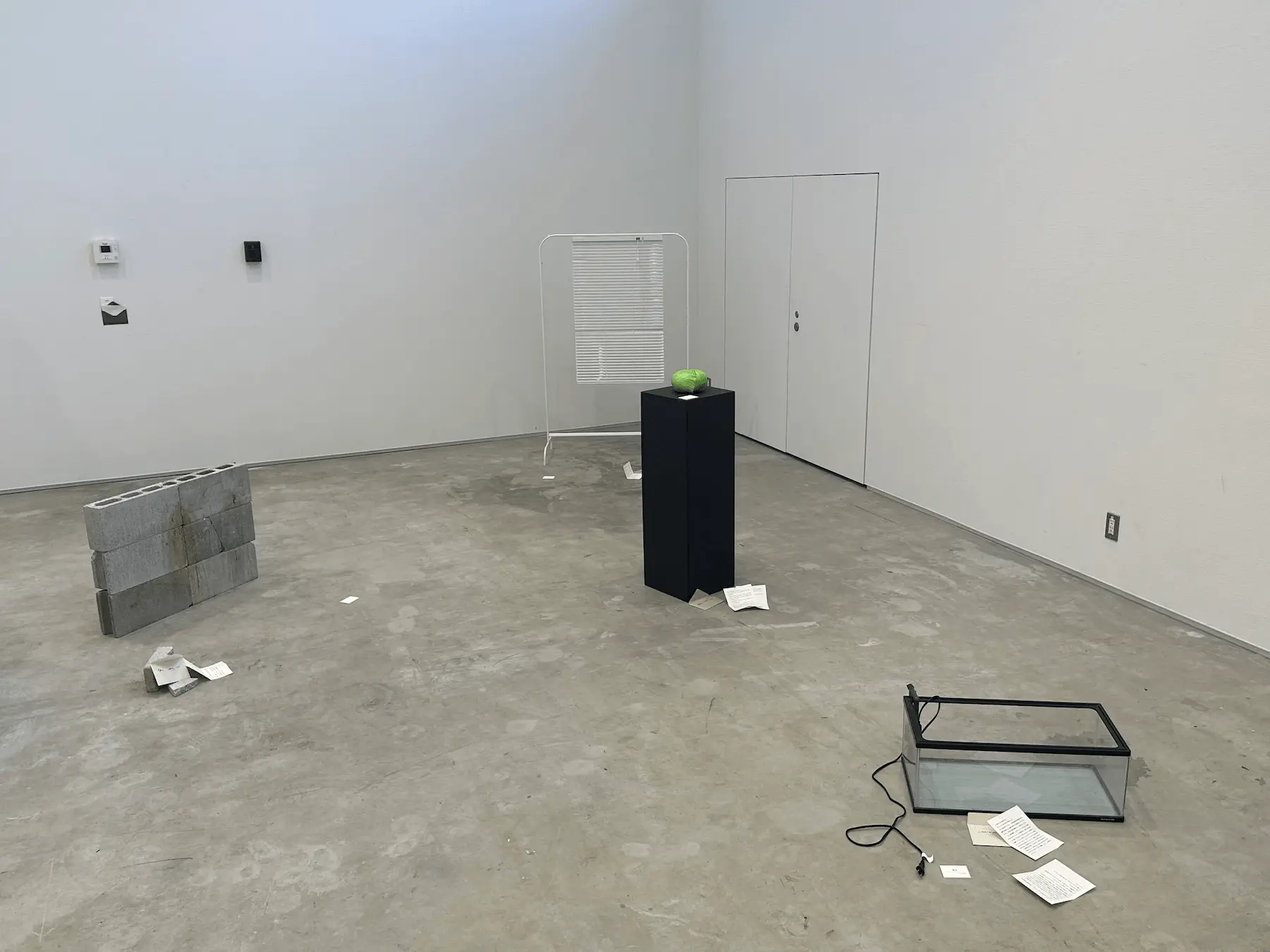
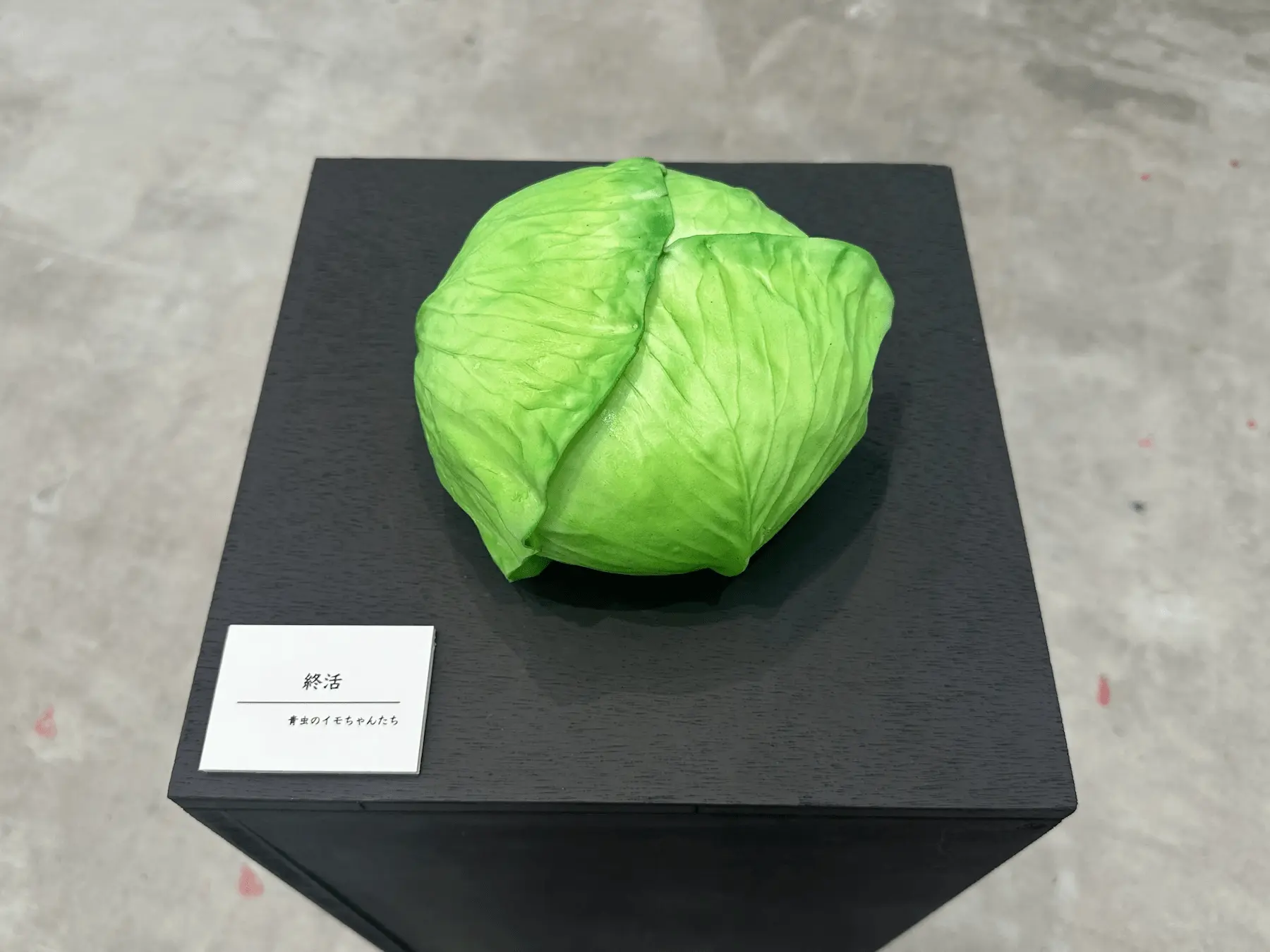
An installation that imagines how everyday objects may have appeared and what meanings they may have held for the creatures with whom I have lived, translating “things” from each of their perspectives.
The installation is composed of everyday ready-made objects, including a plastic cabbage food model, an intercom, an aquarium, blocks, a shutter, letters, and memo pads.
Starting from the possibility that creatures sharing the same space as humans may perceive the same “things” as having entirely different meanings, the work asks whose perception shapes the meaning of an object.
IMAGES / 2023
Installation view / Photo: Hana NAKAMURA
Installation view / Photo: Hana NAKAMURA
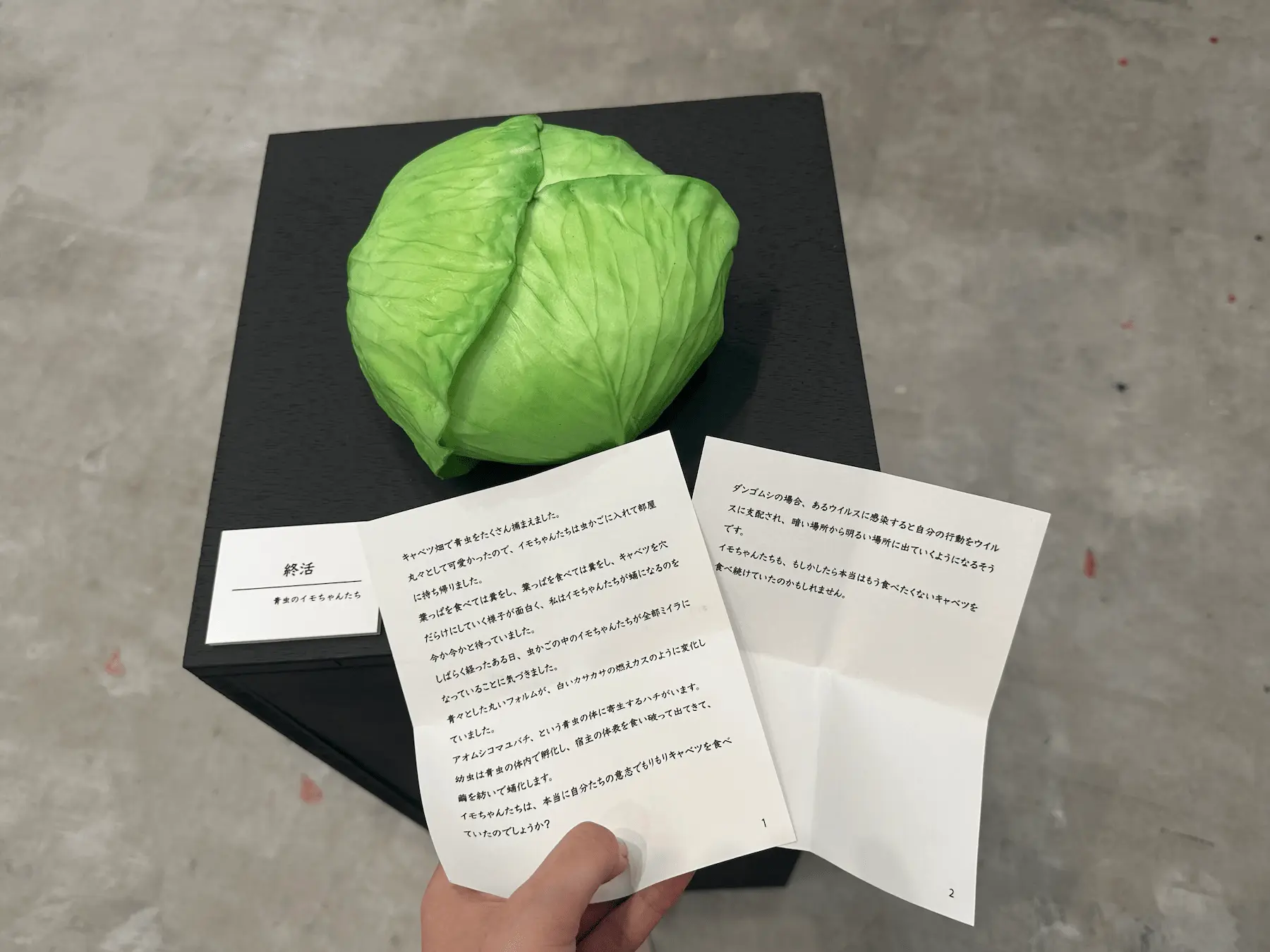
Detail / Photo: Hana NAKAMURA
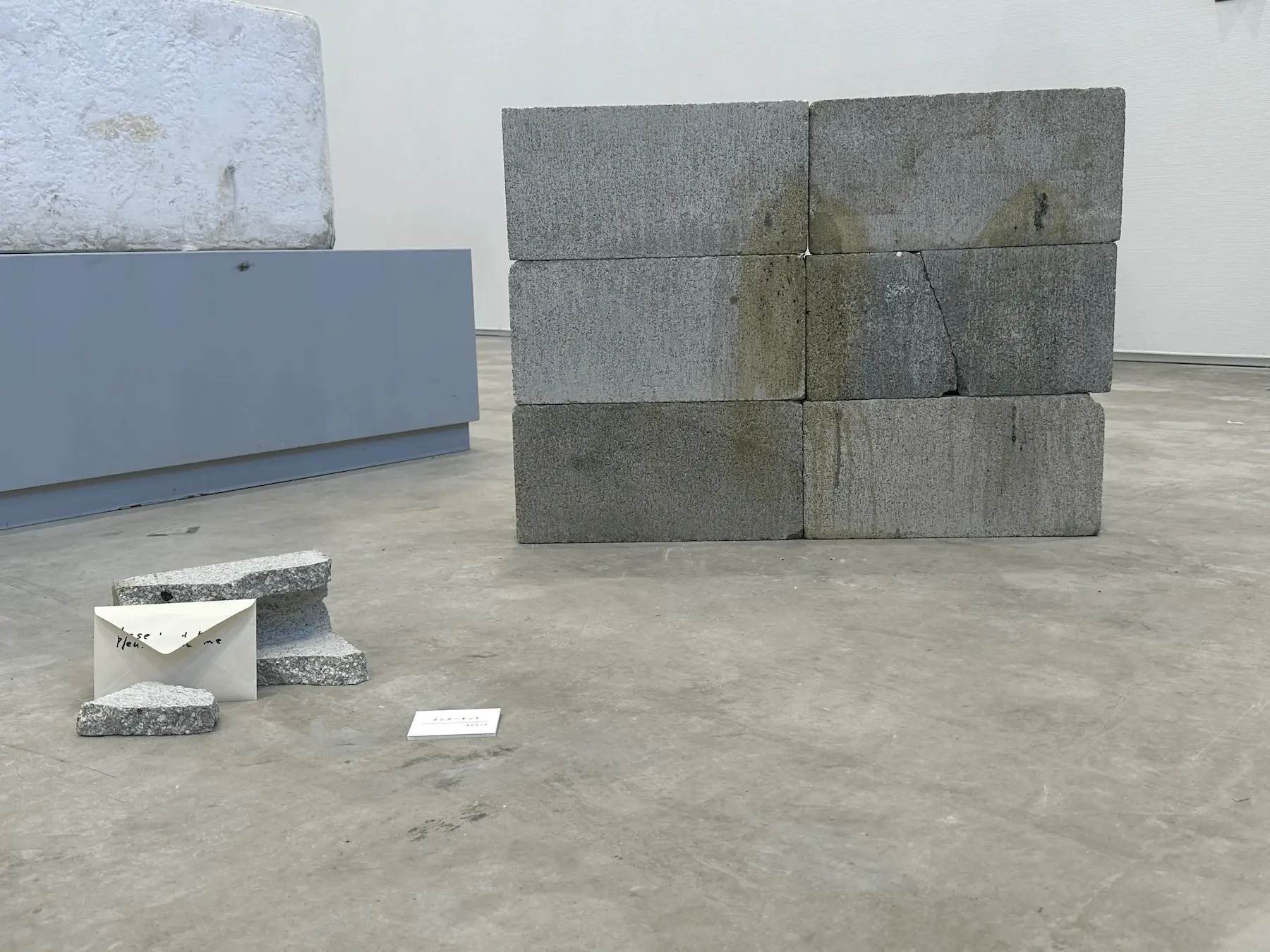
Detail / Photo: Hana NAKAMURA
BACKGROUND / PROCESS / WORK 05
The work began with a thought that emerged from living with many kinds of creatures since childhood: even when looking at the same thing as a human, another creature may recognize it as something with an entirely different meaning.
For example, to a dog an intercom may not be a machine at all, but an “alarm” signaling that a stranger is arriving.
This installation imagines how “things” in a shared living environment may have appeared and what meanings they may have held for the creatures with whom I have lived, translating them into meanings other than human ones.
Ready-made objects such as a plastic cabbage food model, intercom, aquarium, blocks, shutter, letters, and memo pads were selected and reinterpreted from the viewpoints of particular creatures. Multiple translations were placed in the same space, presenting the shared living environment of humans and other creatures as a collection of different meanings.
WORK 06 / 2023
Etude to become an octopus
Artwork
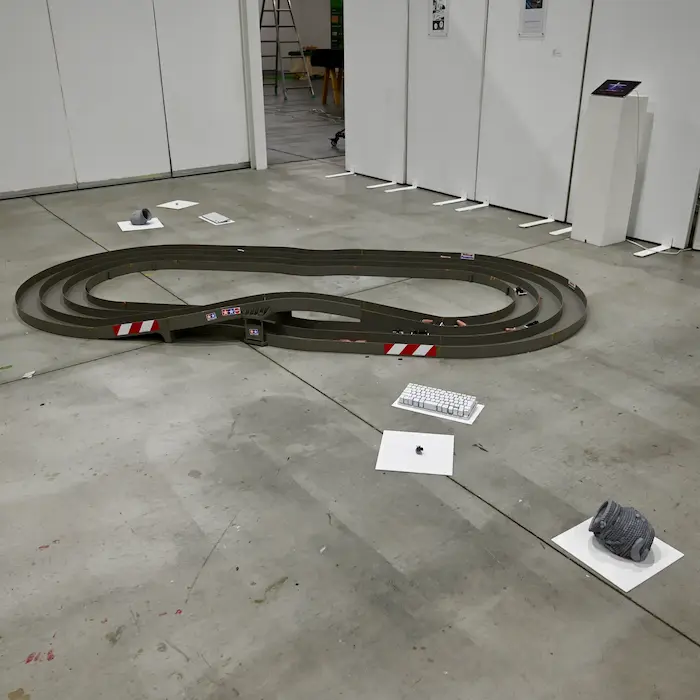
2023
The work is composed of a series of études that introduce different movements and sensations into the human body. Rather than creating a finished image of an octopus, it treats the process of approaching a different kind of body as the work itself.
BACKGROUND / PROCESS / WORK 06
This study began from an interest in imagining the perception and movement of an octopus — a body radically different from the human body — from within my own body. Rather than representing an octopus from the outside, it considers actions and devices for “becoming an octopus.”
The work is composed of a series of études that introduce different movements and sensations into the human body. Rather than creating a finished image of an octopus, it treats the process of approaching a different kind of body as the work itself.
A series of prototypes were made using heterogeneous materials and tools, including 3D prints, sculpture, tights worn on the body, shells, a keyboard, an octopus pot, clay, and paper, in order to alter bodily movement and sensation.
WORK 07 / 2023
My appearance as seen from an octopus
Artwork
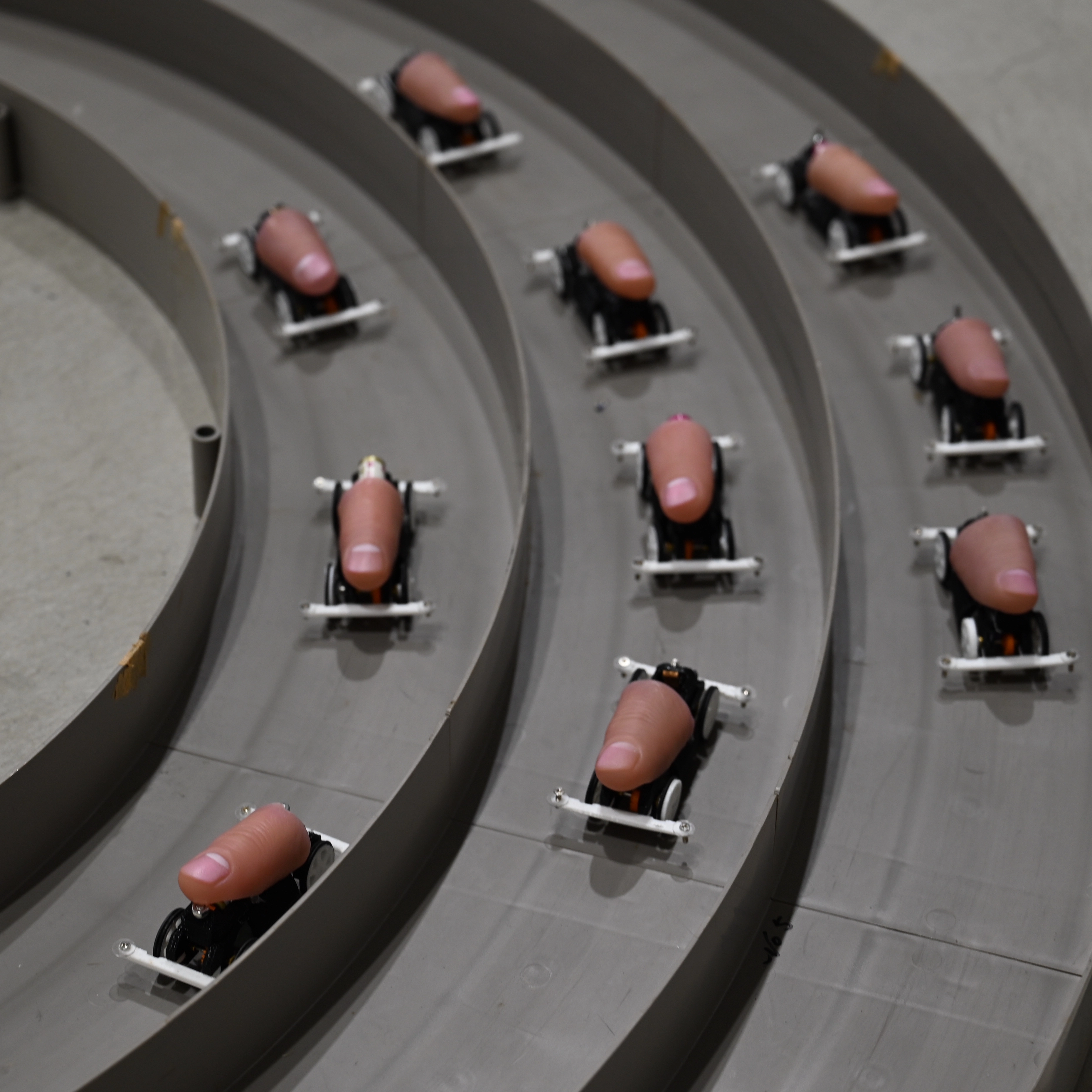
2023
The work expresses “a human as seen by an octopus” not by reproducing the human figure as it is, but by translating its movement and form according to a different set of rules.
BACKGROUND / PROCESS / WORK 07
This work was made as an attempt to imagine how the human figure might appear from the perspective of an octopus, a being with a body radically different from ours.
The work expresses “a human as seen by an octopus” not by reproducing the human figure as it is, but by translating its movement and form according to a different set of rules.
Rubber, motors, 3D-printed parts, 4WD tracks, and other components were combined through electronics and sculptural fabrication to prototype devices and movements that transform the image of the human body.
WORK 08 / 2023
Orbital font
Artwork
2023
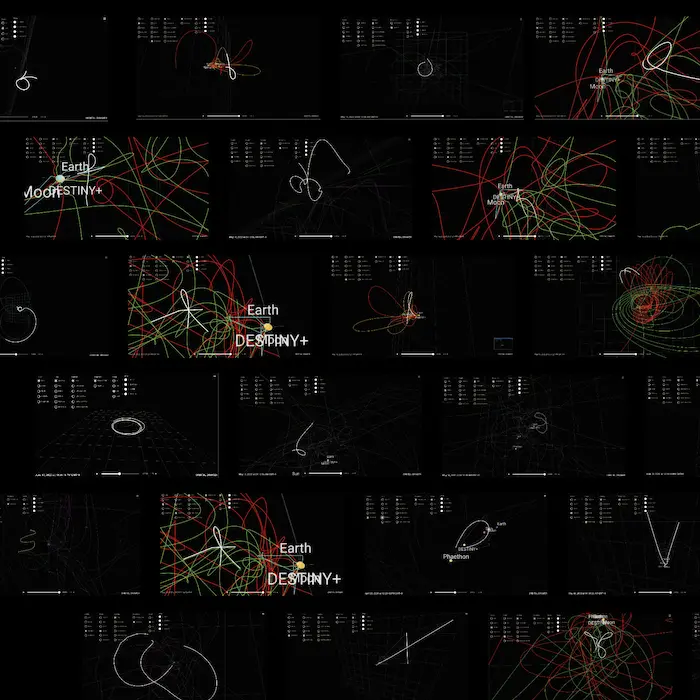
“Orbital Font” extracts lines that appear alphabet-like when three-dimensional orbital trajectories are viewed in two dimensions, and reconstructs them as a type system from A to Z. By changing viewpoint, the work discovers different forms within familiar data.
BACKGROUND / PROCESS / WORK 08
The orbits of the Sun, Earth, Moon, and artificial satellites exist in three dimensions. When projected onto a two-dimensional screen and viewed from different angles, unexpected line forms appear.
“Orbital Font” extracts lines that appear alphabet-like when three-dimensional orbital trajectories are viewed in two dimensions, and reconstructs them as a type system from A to Z. By changing viewpoint, the work discovers different forms within familiar data.
Using Orbit-Drawer, a general-purpose orbital drawing tool developed by the Orbital Art Laboratory, orbital data were observed from a variety of viewpoints and angles to extract forms readable as letters. The resulting characters were catalogued and developed across media including fabric.
WORK 09 / 2021
Archive
Archive
2021
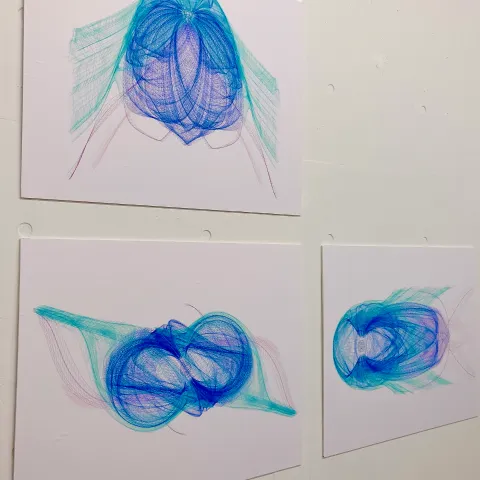
A work that outputs the form of the Van Allen belts surrounding Earth as a three-dimensional object, translating the condition of being “protected by something invisible” into a tangible form.
BACKGROUND / PROCESS / WORK 09
Invisible environments and structures surround Earth and affect the conditions of our lives. The work was developed while searching for a bodily way to perceive this invisible space environment.
A work that outputs the form of the Van Allen belts surrounding Earth as a three-dimensional object, translating the condition of being “protected by something invisible” into a tangible form.
Three-dimensional data were created from the form of the Van Allen belts and output as an object approximately 20 cm in size using a 3D printer and 3D milling machine. Wood and fabricated parts were combined to present an invisible space environment as a physical object.
WORK 10 / 2022
Archive
Archive
2021–22
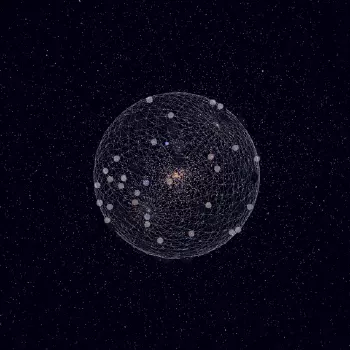
Using stellar data from the Hipparcos satellite, this work converts the distances between Earth and stars into sound. It translates cosmic distances that are otherwise encountered only as numbers into a temporal and auditory experience.
BACKGROUND / PROCESS / WORK 10
The immense distances of space are difficult to understand directly through human bodily perception. By translating astronomical values into another sensory form, the work attempts to reconsider where we are in the universe.
Using stellar data from the Hipparcos satellite, this work converts the distances between Earth and stars into sound. It translates cosmic distances that are otherwise encountered only as numbers into a temporal and auditory experience.
Distance information between stars and Earth was taken from Hipparcos satellite data and converted into sound using Processing. By making differences in the data audible, the work presents a relationship between cosmic scale and our present location.